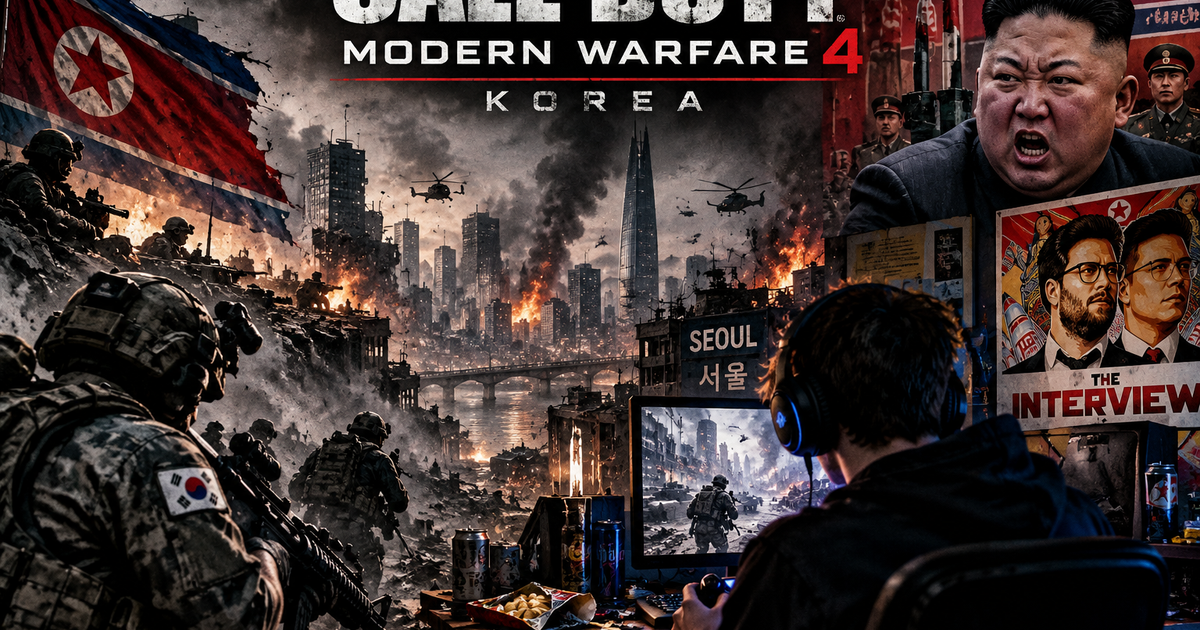
Apparently, fighting Russians, terrorists, zombies, and twelve-year-olds screaming racial slurs into headsets wasn't enough for the Call of Duty franchise. This time, the gaming industry's favorite military recruitment simulator has decided to take its talents to the Korean Peninsula.
And somewhere in Pyongyang, somebody is probably having a fucking aneurysm.
The upcoming Call of Duty: Modern Warfare 4, scheduled for release on October 23, 2026, takes players into a fictional full-scale war between North and South Korea. The storyline follows South Korean soldiers attempting to survive a North Korean invasion, while franchise favorite Captain Price finds himself involved in a much larger international conflict.
It's an ambitious setting for a video game, especially considering the Korean War technically never ended with a peace treaty.
Nothing says family entertainment quite like turning one of the world's most dangerous geopolitical powder kegs into a $70 video game.
But before anyone dismisses the possibility of international outrage over a video game, allow us to take a little trip back to 2014.
Remember When Seth Rogen Almost Started World War III?
In 2014, Seth Rogen and James Franco released The Interview, a comedy about two American idiots recruited to assassinate North Korean dictator Kim Jong Un.
It was exactly the kind of ridiculous Hollywood premise you'd expect from the guys responsible for Pineapple Express.
Unfortunately, North Korea wasn't laughing.
The North Korean government condemned the film, describing its release as an act of war and threatening retaliation if the United States allowed it to reach theaters.
Yes, an actual nuclear-armed government was threatening international consequences over a movie starring the guy from Knocked Up.
Then things got considerably less funny.
In November 2014, hackers calling themselves the Guardians of Peace launched a devastating cyberattack against Sony Pictures, exposing confidential emails, unreleased films, employee information, and other sensitive material.
The FBI publicly attributed the attack to North Korea, although Pyongyang denied responsibility.
Threats against theaters followed, prompting major cinema chains to abandon screenings. Sony initially canceled the movie's nationwide Christmas release before eventually distributing it through limited theaters and digital platforms.
Think about that for a second.
A Hollywood comedy managed to create an international diplomatic incident, trigger a massive cybersecurity crisis, and temporarily scare one of the world's largest entertainment companies into shelving a movie.
All because Seth Rogen made fun of a dictator.
Now imagine what happens when millions of gamers spend their weekends digitally blowing up North Korean tanks.
Press Start to Piss Off a Dictator
Unlike The Interview, the new Call of Duty doesn't center on assassinating Kim Jong Un. The developers have opted for a fictional North Korean leadership rather than directly portraying the ruling Kim family.
A wise decision, considering the last entertainment company to piss off Pyongyang ended up having its dirty laundry dumped across the internet.
Still, the game's premise is hardly subtle.
North Korea invades South Korea. Cities become battlefields. American and South Korean forces fight back. And players get a front-row seat to the kind of military nightmare that defense analysts have spent decades trying to prevent.
Developers at Infinity Ward have emphasized the game's attention to Korean history, culture, and military authenticity. The studio reportedly consulted Korean employees, regional specialists, and North Korean defectors while developing the campaign.
That attention to detail is admirable.
But it's also worth remembering that this isn't some imaginary conflict involving fictional countries.
The Korean Peninsula remains one of the most heavily militarized regions on Earth. Millions of civilians live within reach of a conflict that could escalate catastrophically.
For South Koreans, the prospect of another Korean War isn't simply an exciting campaign setting.
It's a very real national security concern.
And while American gamers are worrying about their kill-to-death ratios, actual military planners are worrying about artillery, missiles, and nuclear weapons.
Slightly different stakes.
The Great North Korean Meltdown of 2026?
The real question isn't whether Modern Warfare 4 will sell millions of copies.
Of course it will.
The question is whether North Korea will decide that another piece of American entertainment constitutes an international insult.
As of this writing, there has been no verified North Korean government response to the game's release comparable to its condemnation of The Interview.
But history suggests that Pyongyang has never been particularly enthusiastic about becoming the punchline of Western entertainment.
And the timing couldn't be more interesting.
With tensions continuing between North and South Korea, the gaming industry has essentially decided to take a hypothetical military catastrophe and turn it into interactive entertainment.
To be fair, Call of Duty has been doing this for decades.
War sells.
Controversy sells.
And nothing moves video games quite like giving players an opportunity to save the world from an international crisis while sitting in their underwear eating Doritos.
The irony is that a franchise built around fictional global warfare could potentially find itself dragged into a very real diplomatic controversy.
Again.
Game Over? Not Quite.
There is, of course, a larger question buried underneath all the explosions, military hardware, and questionable geopolitical decisions.
Should entertainment companies avoid controversial subjects simply because authoritarian governments might get offended?
Absolutely not.
The Interview controversy demonstrated how quickly threats and intimidation can interfere with artistic expression. Regardless of whether anyone thought the movie was funny, allowing governments to dictate what Americans can watch, create, or play sets a dangerous precedent.
At the same time, there's something undeniably strange about transforming an unresolved international conflict into an evening's entertainment.
One country's nightmare becomes another country's downloadable content.
That's the modern entertainment industry in a nutshell.
So as Call of Duty: Modern Warfare 4 prepares to hit consoles, we'll be watching to see whether North Korea responds with its usual collection of angry statements, military rhetoric, and threats of retaliation.
Or perhaps Kim Jong Un will surprise everyone, pick up a controller, and settle his differences with the West in multiplayer.
Although judging by North Korea's history, we're guessing he's more of a rage-quitter.
Welcome to 2026, where World War III might not start with a missile launch.
It might start with a PlayStation notification.