There is something almost impossible to comprehend about what happened in Tennessee on September 30.
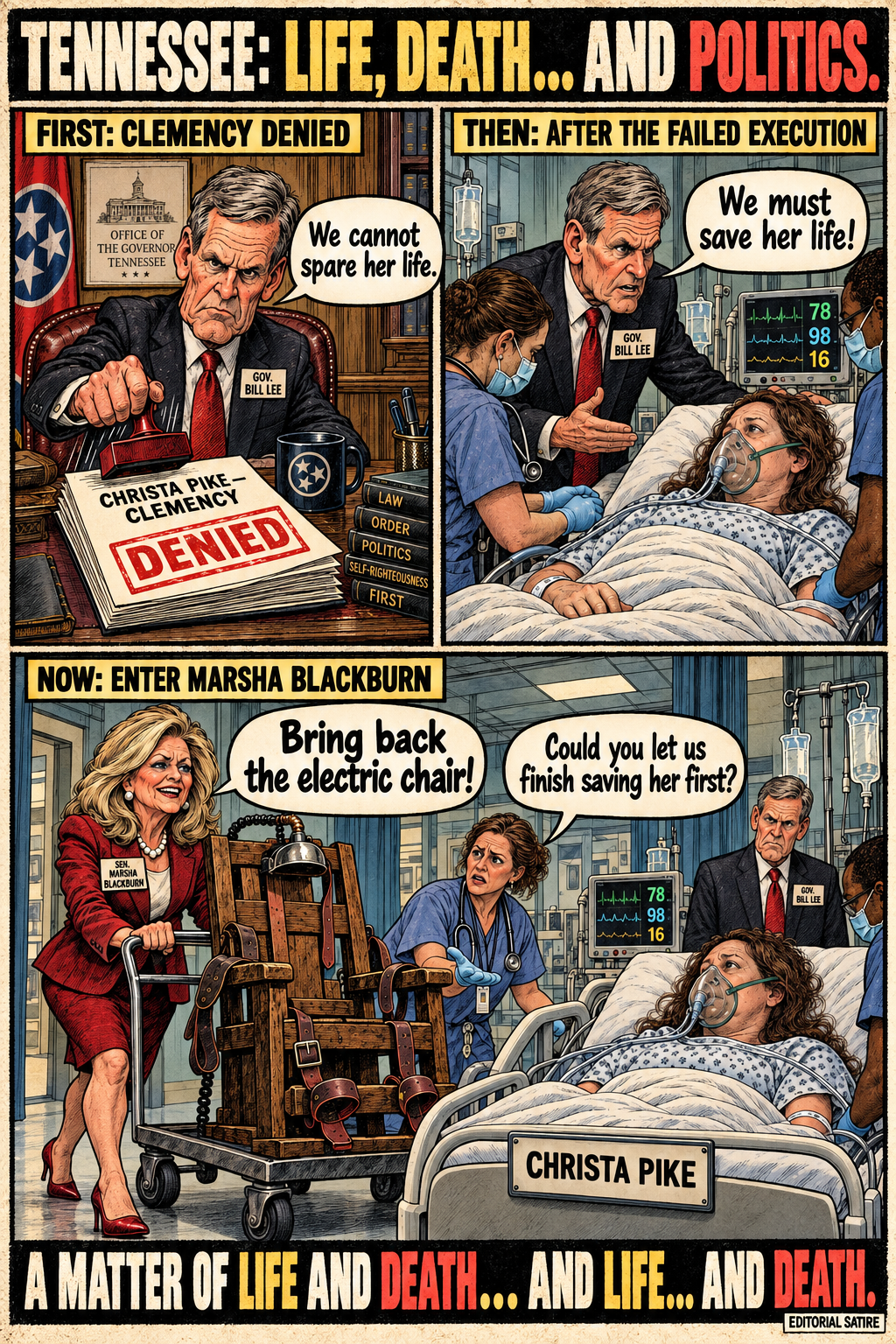
The state strapped Christa Pike down and tried to kill her. Then it tried again, and when that didn't work, an ambulance came to save her.
That isn't a dark joke. It isn't some rejected scene from a dystopian movie. That is essentially what happened after Tennessee attempted to execute Pike, the only woman on the state's death row, for the brutal 1995 murder of 19-year-old Colleen Slemmer. Officials administered two rounds of Tennessee's lethal-injection protocol. Pike survived. She was eventually transported to a hospital, critically ill, where doctors began providing the very thing the government had spent the evening trying to prevent:
Life-saving medical care.
Any serious discussion of Pike's case has to begin with Colleen Slemmer. Pike was 18 when she tortured and killed her classmate, whom she viewed as a potential romantic rival, in 1995. It was a brutal crime, and nothing about questioning capital punishment requires minimizing the severity of what took place.
You can believe that someone committed an unforgivable crime and still question whether government employees should be given the machinery, chemicals, and legal authority to deliberately stop that person's heart. Christa Pike can be guilty. Colleen Slemmer can deserve justice. And the government can still be asked whether it has any business running a death chamber. All three things can exist at once.
Tennessee's execution protocol provided for a second round of injections if the first failed to cause death. So when Pike did not die, they administered another. The protocol apparently had a rather significant hole in it: what happens when the second attempt doesn't work either? The answer turned out to be an ambulance and life-saving care.
Witnesses described the long and confusing process, portions of which occurred with the curtain closed. Pike remained alive after two rounds of pentobarbital, and her attorneys ultimately sought emergency court intervention and medical treatment. Tennessee's own Department of Correction subsequently acknowledged that its protocol allowed no additional procedure after what had already been attempted.
Lethal injection has always carried an interesting bit of theater. The execution chamber doesn't look like a medieval dungeon. There is no chopping block. No hooded executioner swinging an axe. There are tubes, needles, gurneys, chemicals, medical-looking equipment. It resembles healthcare just enough to make the entire process easier to watch. But medicine normally exists to preserve life. Execution exists to deliberately end it.
Pike's case smashed those two worlds together in spectacular fashion. One group of people put chemicals into her body intending to kill her while another group received her afterward and worked to keep her alive. Same human body. Same night. Two completely opposite missions.
Death is the rare government program without an appeals process afterward. That's why the standard cannot simply be: does this person deserve to die? There is another question: Do we trust the state enough to make absolutely certain it gets this right?
After Pike's failed execution, Gov. Bill Lee suspended the state's remaining executions for 2026 and ordered an independent review. The state's correction commissioner subsequently announced his resignation.
Perhaps the most disturbing symbol from Pike's execution wasn't the needle. It was the curtain. Witnesses reported that significant portions of what happened occurred while the execution chamber curtain was closed. One media witness emphasized afterward how much of the process had happened outside public view.
If capital punishment is something society believes is necessary and morally justified, then society should be capable of looking directly at what it has authorized. Not the sanitized phrase. Not lethal injection. Not carrying out the sentence. The actual thing.
The state wanted Christa Pike dead. The courts allowed Tennessee to proceed. The machinery was prepared. The chemicals were administered. Twice. And Christa Pike didn't die. So an ambulance arrived. Doctors went to work. Machines were used to keep her breathing.
There is something almost perfectly American about the contradiction. We built an elaborate legal system to determine whether a person should die. We built an elaborate execution system to make it happen. Then, when that system failed, we activated another elaborate system to save her.
Not whether she committed a terrible crime. She did. Not whether Colleen Slemmer deserved justice. She did. The harder question is what justice requires from the rest of us — because once we give government the power to deliberately take a human life, the debate stops being only about the person lying on the gurney.
It becomes about us. About what we're willing to authorize. About what we're willing to watch. And about what happens when the executioner fails and the doctor has to walk through the door.